
Compare and contrast Ed Smeets (2005) and John Robertson (2002). Make suggestions which would help us provide a more meaningful learning environment, based on your own experience of the use of ICT in the schools you have taught in.
Research on the use and importance of ICT in primary schools is the focus for both articles. There are two immediate differences however; the Smeets (2005) article looks at research conducted in Dutch primary schools while Robertson (2002) focuses on the use of ICT in British primary schools. Aside from this the findings reported in the articles are quite similar. Both find that ICT is not being used as much as it could be nor in the most appropriate ways.
Both Smeets and Robertson talk about drill and practice software and how this is not the most beneficial use of computer programmes in schools. Smeets comments:
teachers who adhered to traditional transmission approaches to instruction, tended to prefer skill-based software
and:
Teacher-centred teachers…tend to use traditional instructional methods, and to regard learning technologies mainly as basic sill reinforcers, motivators or ‘special treats’.
While Robertson quotes David Chandler who noted that:
some forms of ICT, drill and practice software in particular, enabled educational practice to take “a giant step backwards into the 19th Century”
I agree with the point they are both making here. For ICT to be truly effective it needs to be integrated entirely into daily teaching. While working in a year 1 class I saw computers used mainly as a treat for the children to use during golden time or if they finished their work early. The IWB was used mainly as a projector or for the children to use maths programmes during mental starters. Keeping ICT at this distance from the other aspects of teaching and learning must make the children see it as a completely separate tool which can be used only at certain points. ICT really needs to be integrated to such a degree that the children don’t really notice it is there.
Linking in with the drill and practice software, Robertson comments that the ICT which has been introduced so far has led to a lot of passive rather than active learning. Smeets’ article shows different results from the Dutch study in that the majority teachers who completed the questionnaires to provide the research data encouraged their pupils to use ICT independently. This independent work would be used for researching information although it was also found that working in this way was not beneficial for promoting collaborative working meaning that working with ICT would tend to mean that the pupils would be working alone. I have observed this in the year 1 class I worked in, where pupils would have access to individual computers but would be instructed to work alone. The pupils in the year 4 class however were encouraged to work together during their ICT lessons. I believe that it depends on the activity. If an activity is not designed for collaborative working then there is no reason to force it. The pupils will gain as much beneficial experience from working alone on activities as working together.
A point made by Robertson but not mentioned by Smeets is that ICT has not been fully embedded into classrooms which is due to the failure to train, to manage and to resource. Perhaps ICT training and funding in Holland is of such a level that it is not an issue, and it may be for that reason that Smeets did not mention it in his article. It could also be because it was not an area relevant to the research being conducted. I feel that we are heading in the right direction with regards to ICT training in England at least. Because many of today’s trainee teachers have grown up using ICT in one form or another I also believe that incorporating it successfully into everyday teaching will become more natural as tomorrow’s teachers will not be so apprehensive about using it. Smeets remarks that teachers are no longer the all-knowing classroom controllers that they were, but rather they are becoming facilitators of acquiring information and I think the teacher’s role will continue to develop in this way. It will no longer be necessary for teachers to provide fact-based information for pupils but instead equip them with the tools which will enable them to find information for themselves and I feel that this is far more beneficial.
To summarise then, the use of ICT in schools needs to continue to develop in the way it has been for the past few years. It is important that it becomes as integrated as possible and that pupils have continuous access to ICT equipment. Obviously this will depend largely on the finances available to schools but I believe that it is one of the most important areas of learning and so should be financed accordingly. Today’s pupils will need to be ICT literate and primary school is the best time for them to learn.
Wednesday, 23 April 2008

Monday, 18 February 2008
My thoughts on Prensky's Digital Natives, Digital Immigrants parts I and II
Part I:
Prensky raises some interesting points in this article. There are ideas which had not occurred to me prior to my reading it, but which seemed obvious on reflection.
Today’s students are no longer the people our educational system was designed to teach: Prensky explains that they have not just changed incrementally or in terms of style (linguistic and aesthetic) but that changes in the ways they learn and view the world due to the rapid spread of digital technology in recent years. I think this is probably the most important point he makes in the article as we often talk about how the technology is changing but forget (or don’t realise) that the newer generations are adapting and changing with it. So we shouldn’t be concentrating solely on ways of implementing ICT in our schools, but also on how to interact with the digital natives as Prensky calls them.
today’s students think and process information fundamentally differently from their predecessors: Teachers are going to need to understand these differences and how to work with them rather than trying to make the students change their ways of thinking to suit the teaching. It will be difficult for many but I agree that it is something which needs to be done for the sake of these children’s education. If we can’t engage them then not only are they not achieving what they are capable of, but teaching them will be very difficult.
Prensky talks about the differences between digital natives and digital immigrants and I find it interesting that I relate more to the immigrant descriptions. I feel though that there should perhaps be sub-divisions within these categories as there are people who are more ‘immigrant’ than me (my parents for example), and there are those who are less (some of my peers). A person’s up-bringing and personal characteristics also play a part in whether you are native or immigrant as well as which generation you belong to. For example, I have peers who are far more computer literate than I am and I suspect that this is in some part because they want to be, or they may have had more ICT opportunities at school (there was only 1 PC at my primary school which was hardly ever used and my first IT lessons came in my second year at secondary school). I can adapt to new technologies and learn how to use them but I do not have an innate desire to explore ICT as some people I know do.
Digital natives are used to receiving information really fast. They like to parallel process and multi-task: I feel that teaching at the moment is moving towards a faster pace but is still quite slow. Teaching a year 1 class I noticed that they weren’t able to sit still for very long and wanted short, quick explanations even though many of them needed the tasks explaining to them more than once. I suspect that they are at the beginning of their digitally native life and so like to have information quickly but aren’t quite ready yet to process it at the same speed. I agree with Prensky when he comments that they need instant gratification and frequent rewards. This was very evident when teaching.
I don’t think we should discourage the use of ICT in the classrooms (calculators and PCs for example) but I do believe that we need to teach the children how to use them effectively.
Part II
Prensky opens this article with a number of bewildering figures showing the amount of time spent on different ICT activities by digital natives. Seeing this data in black and white confirmed for me that teachers really do need to start changing the way they teach in order to reach these children.
The brain is massively plastic. It can be, and is, constantly reorganized: I was under the impression that the brain had some flexibility to it due to the nature of learning and that when we encounter something new we don’t automatically forget something we already knew (obviously there is a lot of repetition needed to retain information as we have areas of our brain which deal with short and long-term memory), but to learn that it changes physically was very interesting.
Research led by social psychologists shows that people who grow up in different cultures do not just think about different things, they actually think differently: At the moment we are living in what could be called a split culture where we have digital natives and immigrants and it does not surprise me to learn that there could be possible differences in the way each group thinks.
Prensky finds that the amount of practice required when learning a new task reading for example) is similar to the pattern of time spent playing video games by the digital natives. It comes as no surprise then to find that the brains and ways of thinking of these natives are different to the immigrants and I am in agreement with Prensky when he proposes that children’s brains are being ‘reprogrammed’; it seems logical!
When discussing attention spans I find that what Prensky states is what I realised when teaching; that children do appear to have short attention spans when faced with a traditional method of teaching. It is not that they can’t concentrate as they spend hours engrossed in TV, video games, the internet etc, but that this way of teaching was not engaging them as it did not meet their preferred way of thinking. I had come to assume that it was because of the amount of work the children were expected to do that they were not paying attention, that perhaps they were being over-loaded. But in fact I now think that the pace was too slow and so they were switching off..
Reading this article has made me realise that my teaching needs to be not only pitched at the right level but also paced at the right speed. It might be beneficial to teach more in short bursts rather than have a long input and an equally long time when the children are working independently. Short and to the point may be the answer.
Prensky raises some interesting points in this article. There are ideas which had not occurred to me prior to my reading it, but which seemed obvious on reflection.
Today’s students are no longer the people our educational system was designed to teach: Prensky explains that they have not just changed incrementally or in terms of style (linguistic and aesthetic) but that changes in the ways they learn and view the world due to the rapid spread of digital technology in recent years. I think this is probably the most important point he makes in the article as we often talk about how the technology is changing but forget (or don’t realise) that the newer generations are adapting and changing with it. So we shouldn’t be concentrating solely on ways of implementing ICT in our schools, but also on how to interact with the digital natives as Prensky calls them.
today’s students think and process information fundamentally differently from their predecessors: Teachers are going to need to understand these differences and how to work with them rather than trying to make the students change their ways of thinking to suit the teaching. It will be difficult for many but I agree that it is something which needs to be done for the sake of these children’s education. If we can’t engage them then not only are they not achieving what they are capable of, but teaching them will be very difficult.
Prensky talks about the differences between digital natives and digital immigrants and I find it interesting that I relate more to the immigrant descriptions. I feel though that there should perhaps be sub-divisions within these categories as there are people who are more ‘immigrant’ than me (my parents for example), and there are those who are less (some of my peers). A person’s up-bringing and personal characteristics also play a part in whether you are native or immigrant as well as which generation you belong to. For example, I have peers who are far more computer literate than I am and I suspect that this is in some part because they want to be, or they may have had more ICT opportunities at school (there was only 1 PC at my primary school which was hardly ever used and my first IT lessons came in my second year at secondary school). I can adapt to new technologies and learn how to use them but I do not have an innate desire to explore ICT as some people I know do.
Digital natives are used to receiving information really fast. They like to parallel process and multi-task: I feel that teaching at the moment is moving towards a faster pace but is still quite slow. Teaching a year 1 class I noticed that they weren’t able to sit still for very long and wanted short, quick explanations even though many of them needed the tasks explaining to them more than once. I suspect that they are at the beginning of their digitally native life and so like to have information quickly but aren’t quite ready yet to process it at the same speed. I agree with Prensky when he comments that they need instant gratification and frequent rewards. This was very evident when teaching.
I don’t think we should discourage the use of ICT in the classrooms (calculators and PCs for example) but I do believe that we need to teach the children how to use them effectively.
Part II
Prensky opens this article with a number of bewildering figures showing the amount of time spent on different ICT activities by digital natives. Seeing this data in black and white confirmed for me that teachers really do need to start changing the way they teach in order to reach these children.
The brain is massively plastic. It can be, and is, constantly reorganized: I was under the impression that the brain had some flexibility to it due to the nature of learning and that when we encounter something new we don’t automatically forget something we already knew (obviously there is a lot of repetition needed to retain information as we have areas of our brain which deal with short and long-term memory), but to learn that it changes physically was very interesting.
Research led by social psychologists shows that people who grow up in different cultures do not just think about different things, they actually think differently: At the moment we are living in what could be called a split culture where we have digital natives and immigrants and it does not surprise me to learn that there could be possible differences in the way each group thinks.
Prensky finds that the amount of practice required when learning a new task reading for example) is similar to the pattern of time spent playing video games by the digital natives. It comes as no surprise then to find that the brains and ways of thinking of these natives are different to the immigrants and I am in agreement with Prensky when he proposes that children’s brains are being ‘reprogrammed’; it seems logical!
When discussing attention spans I find that what Prensky states is what I realised when teaching; that children do appear to have short attention spans when faced with a traditional method of teaching. It is not that they can’t concentrate as they spend hours engrossed in TV, video games, the internet etc, but that this way of teaching was not engaging them as it did not meet their preferred way of thinking. I had come to assume that it was because of the amount of work the children were expected to do that they were not paying attention, that perhaps they were being over-loaded. But in fact I now think that the pace was too slow and so they were switching off..
Reading this article has made me realise that my teaching needs to be not only pitched at the right level but also paced at the right speed. It might be beneficial to teach more in short bursts rather than have a long input and an equally long time when the children are working independently. Short and to the point may be the answer.
Changing Paradigms by Marc Prensky
I found the article Chaning Paradigms by Marc Prenksy very interesting and thought that it highlighted some important points. My thoughts are below:
In this article Prensky discusses the idea that education today, in today’s technologies, is utterly removed from that of the past. Students of all ages do not want to be lectured to, they want to be able to find information out for themselves and use it in a way that is appropriate to them.
I think that in order to be able to teach in the twenty-first century we don’t need to focus on which technologies we are using, but rather how we and the students can use them. I feel that there is so much concern about giving didactic lessons on how to use certain computer programs when what we should be doing is focusing on the task rather than the equipment. We need to treat computers and other ICT equipment as we treat pens and paper; it’s there, we all use it and it’s going to remain in our society for a long time.
Engaging the children and motivating them to want to learn is the most important aspect of teaching and if we continue to read out our PowerPoint presentations then we are doing neither of these things and the children will become bored.
I agree with Prensky in that we need to devise challenges for the children which give them the opportunity to investigate, share and discuss with their peers. I feel that education is no longer about simply telling the children something to remember in order that they pass the exams, children need to learn to investigate and solve problems for themselves and they need to use ICT to do that because, let’s face it, it’s what they do best.
I don’t agree with Prensky when he comments that the demise of the classroom isn’t far away, I think that classrooms won’t be used as we use them now, but that they will become more of a meeting place for groups of children embarking on investigative work, and undoubtedly they will eventually be filled with numerous examples of ICT equipment.
In this article Prensky discusses the idea that education today, in today’s technologies, is utterly removed from that of the past. Students of all ages do not want to be lectured to, they want to be able to find information out for themselves and use it in a way that is appropriate to them.
I think that in order to be able to teach in the twenty-first century we don’t need to focus on which technologies we are using, but rather how we and the students can use them. I feel that there is so much concern about giving didactic lessons on how to use certain computer programs when what we should be doing is focusing on the task rather than the equipment. We need to treat computers and other ICT equipment as we treat pens and paper; it’s there, we all use it and it’s going to remain in our society for a long time.
Engaging the children and motivating them to want to learn is the most important aspect of teaching and if we continue to read out our PowerPoint presentations then we are doing neither of these things and the children will become bored.
I agree with Prensky in that we need to devise challenges for the children which give them the opportunity to investigate, share and discuss with their peers. I feel that education is no longer about simply telling the children something to remember in order that they pass the exams, children need to learn to investigate and solve problems for themselves and they need to use ICT to do that because, let’s face it, it’s what they do best.
I don’t agree with Prensky when he comments that the demise of the classroom isn’t far away, I think that classrooms won’t be used as we use them now, but that they will become more of a meeting place for groups of children embarking on investigative work, and undoubtedly they will eventually be filled with numerous examples of ICT equipment.
Monday, 4 February 2008
Final blog
So, here it is, the final, in reasonable length list of blog entries. When we were first told that we were to create a blog which would be updated regularly I have to say that I was a bit sceptical and not particularly interested in doing it. However, after quite a few months of frequent blogging I have actually enjoyed the experience and often looked forward to composing my entry.
I have found this blog site very easy to use not only in writing but also for attaching photos and weblinks. I have created a few hyperlinks in this blog as a whole and this is a very useful skill which I will definitely take with me long after the blogging has stopped.
I doubt I would ever blog again merely because I don't really have anything to blog about and I'm not sure exatly who would be interested enough to read what I might write, but I can see how useful it is as a form of communication and have actually added the blog of a famous write/actor/presenter to my favourites, and yes I do read it often!
In a school context I think blogging could be useful in KS2 for the children to write about the topics they are currently studying or even to keep up with school work while on holiday or ill. For them to have access to other people's blogs, say at a school in a different country, would be beneficial as there is much they could learn and the information they would be receiveing would be coming straight from the source. I think then that blogs are useful educational tools also and I hope that I see them used in schools.
On the whole this has been a useful exercise in that it has introduced me to new aspects of ICT and if I do feel the need to creat a blog again in the future then I have the skills at my disposal.
It has been a pleasure.
I have found this blog site very easy to use not only in writing but also for attaching photos and weblinks. I have created a few hyperlinks in this blog as a whole and this is a very useful skill which I will definitely take with me long after the blogging has stopped.
I doubt I would ever blog again merely because I don't really have anything to blog about and I'm not sure exatly who would be interested enough to read what I might write, but I can see how useful it is as a form of communication and have actually added the blog of a famous write/actor/presenter to my favourites, and yes I do read it often!
In a school context I think blogging could be useful in KS2 for the children to write about the topics they are currently studying or even to keep up with school work while on holiday or ill. For them to have access to other people's blogs, say at a school in a different country, would be beneficial as there is much they could learn and the information they would be receiveing would be coming straight from the source. I think then that blogs are useful educational tools also and I hope that I see them used in schools.
On the whole this has been a useful exercise in that it has introduced me to new aspects of ICT and if I do feel the need to creat a blog again in the future then I have the skills at my disposal.
It has been a pleasure.
Sunday, 27 January 2008
Third week at school
This week I was able to use the IWB with powerpoint. I was doing a number quiz with the class as a starter to a maths lesson and they thoroughly enjoyed it. I think it worked much better than simply reading the questions and it seems to me that the children are a little more motivated in their work when they have technological stimulus. I'm not sure if this is because they are used to most things being fast paced or if they simply enjoy the graphics which can be used on the computers, either way they all tried really hard in the quiz!
Aside from that I taught my second ICT lesson which involved teaching them how to use the shift key. The vast majority of the class knew that they had to press the 'arrow button' to make a capital letter but they didn;t know what it was called. The ICT lessons are only between 15 and 20 minutes and the children are always eager to demonstrate what they have learnt.
Aside from that I taught my second ICT lesson which involved teaching them how to use the shift key. The vast majority of the class knew that they had to press the 'arrow button' to make a capital letter but they didn;t know what it was called. The ICT lessons are only between 15 and 20 minutes and the children are always eager to demonstrate what they have learnt.
Tuesday, 22 January 2008
Second week at school
I have had a little more contact with ICT during my second week on placement. I showed a short film of The Three Little Pigs during a literacy lesson, The film was used as a discussion stimulus in which the children asked and answered questions about the setting, characters, colours and language. The film was approximately 10 minutes long which meant that the children didn't have too much information to take in nor were they watching the television for too long.
The TV time they have during the teachers' PPA is spent watching videos relating to the topics they are covering in other subjects. I have not yet participated in the TV time but I hope to before the placement ends. I asked the children what they think of this time and most of them said that they found it boring commenting also that too much TV is bad for you. When I mentioned that their TV time is only 15 minutes a week they pointed out that they watch a lot of TV at home so they don't want to watch it at school as well, many of them said they would prefer to do something creative like painting or collaging during this time. I found this interesting as I had (wrongly) assumed that they would enjoy TV time.
The children have access to digital cameras occasionally and really enjoy using them to film each other. I assisted with a lesson in which the children were hotseating characters from The Three Billy Goats Gruff in pairs, and these 'hotseats' were filmed. The children enjoy making and watching these films and I hope to have an opportunity to use them in one of my lessons.
The TV time they have during the teachers' PPA is spent watching videos relating to the topics they are covering in other subjects. I have not yet participated in the TV time but I hope to before the placement ends. I asked the children what they think of this time and most of them said that they found it boring commenting also that too much TV is bad for you. When I mentioned that their TV time is only 15 minutes a week they pointed out that they watch a lot of TV at home so they don't want to watch it at school as well, many of them said they would prefer to do something creative like painting or collaging during this time. I found this interesting as I had (wrongly) assumed that they would enjoy TV time.
The children have access to digital cameras occasionally and really enjoy using them to film each other. I assisted with a lesson in which the children were hotseating characters from The Three Billy Goats Gruff in pairs, and these 'hotseats' were filmed. The children enjoy making and watching these films and I hope to have an opportunity to use them in one of my lessons.
Sunday, 13 January 2008
First week at school
During this first week at school I have not had any contact with ICT. The IWB has been awaiting repair and I have not observed nor taken part in lessons using ICT. However, the children in the class (year 1) have access to 3 computers which they can use once they have completed the 'must do' jobs that day. Many choose to use the same programme which offers a range of activites from drawing to practising maths. The children are eager to use the computers and often work in pairs so that most of the class can gain access.
During PPA time the LSAs take the children for half an hour to watch TV. I've not yet observed this part of the day but I hopefully will this week as I am eager to see exactly what they are watching as they all seem extremely excited to go.
I am hopeful that the IWB will be working this week so that I can incorporate it into my lessons.
During PPA time the LSAs take the children for half an hour to watch TV. I've not yet observed this part of the day but I hopefully will this week as I am eager to see exactly what they are watching as they all seem extremely excited to go.
I am hopeful that the IWB will be working this week so that I can incorporate it into my lessons.
Sunday, 16 December 2007
The Use of Discussion Boards
I don't feel that using a discussion board to analyse the graphs was particlarly useful. As we were partnered with somebody in our group I think it would have been better to look at the graphs together and talk face to face then post our thoughts, rather than going through the discussion board.
I'm not sure how I would use discussion boards in school, the only way I thin they could be really usefule would be for discussions between schools.
I'm not sure how I would use discussion boards in school, the only way I thin they could be really usefule would be for discussions between schools.
Tuesday, 27 November 2007
Flabbergasting
I know this is probably not ideal for a blog entry but I literally have no words to describe this video other than flabbergasting!...
Brainwaves control computers
Brainwaves control computers
Thursday, 22 November 2007
How would you like to pay? cash? card? or fingerprint?
 I came across a piece of news (on the BBC website) about customers in Germany being able to pay in shops with their fingerprints. The journalist explains at the start of the film that your fingerprints will need to be registered in order that you can use them as a sort of debit card, although he doesn't explain exactly how this works. This does have obvious benefits in that you can't lose your fingerprints like you can money or cards, and fraud would be quite difficult unless spy thriller films are to be believed.
Watch the video here
I decided to find more articles about payment by fingerprint and there are apparently some branches of the Co-op around Oxford which use this technology:
I am rather sceptical as to whether this is actually real, but if not it is rather scary; science fiction becoming reality.
I do wonder about the last part of the article regarding the Oxford Co-ops:
Builders could have problems because the manual work wears down their fingerprints and surgeons face similar problems because of all the hand-washing they do.
Can you really wear you fingerprints away through excessive handwashing and manual labour? I feel this needs more investigation.
Image from BBC news website. Address above.
Tackling bullying online
With the creation of social networking and sharing websites (YouTube and Facebook for example) came a new platform for bullying. It has been widely documented that cyber-bullying is now quite prevalent in our society with mobile phones being used as the filming tools for such attacks (be they verbal or physical). The videos are then uploaded on these sites for literally the whole world to see. This is quite clearly very wrong, but with everything else adapting and changing to keep up with new developments then it should have been anticipated that bullying would too. I came across this news article about an attempt to combat cyber-bullying by YouTube:
http://news.bbc.co.uk/1/hi/education/7098978.stm
I had a look at the actual campaign on YouTube and I have to say that I found it really uninspiring, quite dull and not very useful. There is a myriad of "celebrities" talking about the Beatbullying campaign and about their views on bullying in general. Most of the clips shows very stilted people talking in monotone voices and not really making any effort to highlight the problem. It seems that they are simply reading off cuecards and the overall impression is of busy people who have taken a few minutes out of their schedules to "support" this campaign and to be honest, I don't personally believe that they believe or feel greatly about the cause. Putting "famous" (I invert it as I didn't recognise half of these people, though children probably will!) people on the front of these campaigns doesn't necessarily give them any weight, and it is definitely not a solution.
The video
http://news.bbc.co.uk/1/hi/education/7098978.stm
I had a look at the actual campaign on YouTube and I have to say that I found it really uninspiring, quite dull and not very useful. There is a myriad of "celebrities" talking about the Beatbullying campaign and about their views on bullying in general. Most of the clips shows very stilted people talking in monotone voices and not really making any effort to highlight the problem. It seems that they are simply reading off cuecards and the overall impression is of busy people who have taken a few minutes out of their schedules to "support" this campaign and to be honest, I don't personally believe that they believe or feel greatly about the cause. Putting "famous" (I invert it as I didn't recognise half of these people, though children probably will!) people on the front of these campaigns doesn't necessarily give them any weight, and it is definitely not a solution.
The video
Using ICT over the past 2 weeks
Apart from checking my email account, searching for online journals and creating Word documents I have not really used computers over the past two weeks. I only really use my mobile phone for making/ receiving calls or sending/receiving text messages and often forget that I have camera and web browsing facilities on there. These factors have confirmed a long held belief of mine, that I'm not someone who is very reliant nor indeed particularly enticed by technology. I do not need to have the latest, fastest, biggest (or smallest as in most cases with new technologies) piece of equipment available. I am not saying that I do not enjoy using the technology I have got but that if I did not have it, then I wouldn't feel lost or lacking.
However, there is one advantage I have noticed about the use of ICT on this course and that is uploading our ICT work onto EPS. This process feels a lot less cluttered than the mountains of physical paperwork we need to keep for other subjects. Whilst at a previous job I would frequently be told that we were now a paper-less society where every task was carried out on the computer, at the same time as being told that I needed to make a hard copy (and by that they meant on paper of course) of everything I had just done on the computer; twice the work for half the success.
I feel that if we really want to be a paper-less society then we should just bite the bullet and go for it, no more second copies to be housed in filing cabinets the length of the room.
I would need to draw the line at books though; they are designed to be made of paper and no matter how cleverly engineered e-books may be they will never be able to replicate opening a new book for the first time, the sound of pages turning and a wonderful array of bookshelves brimming with paper- and hardbacks. I will say the same for newspapers, I can only tolerate reading a very short newspaper article online, I would much rather have a real one on the table in front of me.
Image from http://www.eximiousbooks.com/cgi-bin/exb455/index.htmlsbooks.com/cgi-bin/exb455/index.html

However, there is one advantage I have noticed about the use of ICT on this course and that is uploading our ICT work onto EPS. This process feels a lot less cluttered than the mountains of physical paperwork we need to keep for other subjects. Whilst at a previous job I would frequently be told that we were now a paper-less society where every task was carried out on the computer, at the same time as being told that I needed to make a hard copy (and by that they meant on paper of course) of everything I had just done on the computer; twice the work for half the success.
I feel that if we really want to be a paper-less society then we should just bite the bullet and go for it, no more second copies to be housed in filing cabinets the length of the room.
I would need to draw the line at books though; they are designed to be made of paper and no matter how cleverly engineered e-books may be they will never be able to replicate opening a new book for the first time, the sound of pages turning and a wonderful array of bookshelves brimming with paper- and hardbacks. I will say the same for newspapers, I can only tolerate reading a very short newspaper article online, I would much rather have a real one on the table in front of me.
Image from http://www.eximiousbooks.com/cgi-bin/exb455/index.htmlsbooks.com/cgi-bin/exb455/index.html

Tuesday, 6 November 2007
Mobile phones in schools
We have discussed this briefly in an ICT session and also in a bit more depth on the discussion board on blackboard. I have just read an article in The Teacher (NUT magazine) about this issue and it seems to be a current theme concerning teachers. The article is made up of three emails/letters sent in by teachers detailing their thoughts about mobile phones in schools. Two of these teachers talk about the problems they have encountered with pupils having phones in schools, while the third suggests a novel way of encouraging children to keep their phones turned off in lessons:
At the end of the class (as long as pupils have resisted using their mobiles) the teacher writes something up on the board which reinforces something from the lesson. Children get mobiles out and, as quick as they can, copy out this message in text speak.
The fastest few get points for the 'text league table' display in the classroom (children love seeing their name on display in a football style league table) and winner at the end of term gets a small top-up mobile gift voucher.
This is quite a novel idea and I can see how it could work with children in a certain age range(upper KS2, lower KS3). Banning children from having their phones at school may not necessarily work but allowing them to use them in this way shows that the teacher respects their ability to be responsible which would hopefully have a positive effect on the pupils' attitude to using their phones at school.
I think teachers are going to have to come up with ideas like this as the technology children have access to develops further, and we know that the use of ICT in schools is becoming increasingly important.
(Article can be found in November issue of The Teacher, p.45)
At the end of the class (as long as pupils have resisted using their mobiles) the teacher writes something up on the board which reinforces something from the lesson. Children get mobiles out and, as quick as they can, copy out this message in text speak.
The fastest few get points for the 'text league table' display in the classroom (children love seeing their name on display in a football style league table) and winner at the end of term gets a small top-up mobile gift voucher.
This is quite a novel idea and I can see how it could work with children in a certain age range(upper KS2, lower KS3). Banning children from having their phones at school may not necessarily work but allowing them to use them in this way shows that the teacher respects their ability to be responsible which would hopefully have a positive effect on the pupils' attitude to using their phones at school.
I think teachers are going to have to come up with ideas like this as the technology children have access to develops further, and we know that the use of ICT in schools is becoming increasingly important.
(Article can be found in November issue of The Teacher, p.45)
Saturday, 3 November 2007
Technology
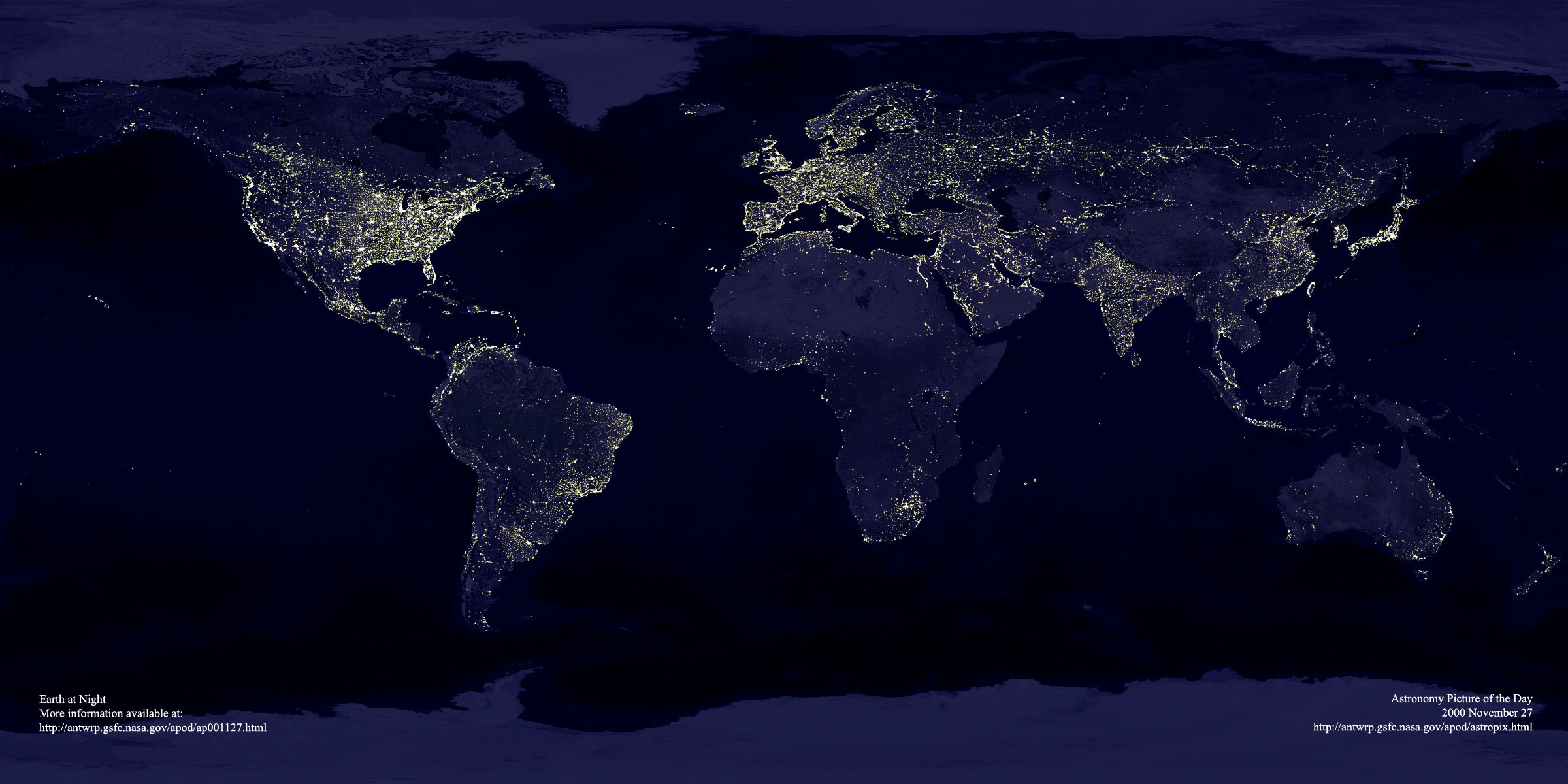 The use of different technologies is being embraced in schools (from what I've seen). We are encouraging children to explore the computers, cameras, phones etc which surround them promoting it as a useful experience which will enhance their learning capabilities and make them open to future developments. This is fine, and something I agree with due to the way the technological world is changing and expanding, but at what cost to the natural world? I do my (little) bit for the environment (recycling, turning lights off when leaving a room etc) and I'm not one to get into lengthy discussions about our carbon footprint or berate people who still receive their bank statements in the post rather than via email. It is fair enough to use less paper when we can do things electronically, but is using all this technology really much better and less damaging? I came across this photo and it had quite a sobering effect. This is what the earth looks like at night. According to the website it is made of a composite of many photos (obviously as we all know that every country doesn't experience night at the same time) and I think it is quite powerful. The image was taken in 2000, I wonder how much of a change the last 7 years has made.
This is the website
Thursday, 1 November 2007
IWBs
This being our placement week I thought I would take advantage and familiarise myself with the IWB. The majority of the activities seemed quite useful if a bit simple, and there were a few which didn't seem as though they would actually enhance learning in any way. The writing tool was what I wanted to practice with most and, as I suspected, it proved to be rather tricky as I had to make sure to position myself in such a way that I didn't cast a shadow on what I was writing, that my writing was level and legible and that I didn't blind myself with the projector bulb! Needless to say my practising was done when the children had gone home! After 45 minutes though I became quite confident in using the programmes available although I will still have to work on where I stand, perhaps if the projector was somewhere else or the board at an angle it might make a difference.
Lessons in excellence
Feel much better about excel following the last ICT session we had, it answered the questions I had and any doubts have now gone. I shall try and practice with it to make sure that I'm totally confident. Still a bit rusty with the graphs but that will come with time.
Friday, 19 October 2007
EXCELlent?
I don't remember having used excel to draw graphs before, I certainly knew that you could but never needed to. I used to use it at my previous job for creating very, very simple tables to record information but that was it. Having to create graphs for science was quite challenging and I found that the "help" didn't really help either, it was far too complicated and didn't really answer my query (or do I think that just because I found it complicated?!). I managed to complete the task in the end and created a pie chart, bar graph, a couple of scattergrams (I enjoyed doing those!) and an attempt at a histogram. The histogram proved difficult as there wasn't a function on excel which enabled me to put in the data and create one, so I had to resort to adapting a bar chart. I still don't know if it is right. So after all that I now feel confident tackling simple graphs and data on excel, although I can't remember how to make it do sums, I'll have to look up how to input a formula and have a go.
Tuesday, 16 October 2007
wiki, wiki, woo!
Today was the day I edited a wiki for the first time. I have visited Wikipedia in the past but never really had the desire or need to post anything on a wiki before, but after doing it today I can say that I found it easy (even creating a hyperlink which I thought would be difficult). The wiki we're using for the PGCE resources looks useful, I'll try and find some things to post on there...
Children using ICT
From reading various articles over the past couple of weeks it has become apparent that children learn more about computers at home than they do at school (though I think this was pretty evident without needing to read the articles!). I'm sure schools will catch up, but by that time the children will probably have moved on to more complex forms of ICT, maybe they should teach the teachers!
Tuesday, 9 October 2007
First blog

I have a blog?!
So apparently this is my blog which, by February, will be full of amazing insights into my thoughts on the ICT aspect of the PGCE. I shall start by saying that last week was the first time I ever used Publisher and to be honest it wasn't particularly difficult or that exciting. If I get a few spare minutes (!) I might have a play around and see what designs I come up with...perhaps.
Subscribe to:
Posts (Atom)